Bathroom lighting does more heavy lifting than most homeowners realize. It’s not just about seeing yourself in the mirror, proper lighting affects everything from morning routines to safety, resale value, and energy bills. Home Depot stocks one of the widest selections of bathroom fixtures available, from builder-grade basics to designer-worthy statement pieces. Whether you’re upgrading a powder room or gutting a master bath, understanding what’s available and how to choose the right fixtures can save time, money, and a lot of installation headaches down the road.
Table of Contents
ToggleKey Takeaways
- Home Depot bathroom lighting selections include 2,000+ options ranging from budget-friendly to designer fixtures, with convenient in-store availability and free ship-to-store service for out-of-stock items.
- Proper bathroom lighting requires layered design combining task lighting from vanity lights or sconces with general illumination from recessed or flush-mount fixtures to eliminate shadows and enhance functionality.
- Choose bathroom lighting with a CRI of 90 or higher and a color temperature between 3,000K to 4,000K to render skin tones accurately, and always verify fixtures are damp-rated or wet-rated if installed within 3 feet of water.
- Matte black finishes, LED strip backlighting, mixed metals, and smart-enabled fixtures are the leading bathroom lighting trends for 2026, offering both modern aesthetics and enhanced control.
- DIY fixture swaps typically take 30–60 minutes on existing junction boxes, but adding new recessed lights or circuits requires careful planning for moisture control, electrical load capacity, and potential permit requirements.
Why Home Depot for Bathroom Lighting?
Home Depot carries roughly 2,000+ bathroom lighting options at any given time, ranging from $15 flush mounts to $800+ multi-light chandeliers. That breadth means DIYers can compare styles, finishes, and price points in one trip instead of bouncing between specialty showrooms.
Another advantage: in-store availability. Unlike ordering online and waiting weeks for delivery, most Home Depot locations stock popular vanity lights, flush mounts, and LED retrofits on the shelf. If a fixture is out of stock locally, ship-to-store is typically free and arrives within a few days.
Home Depot also bundles installation services for customers who’d rather not wire fixtures themselves. Pricing varies by region and complexity, but it’s often cheaper than hiring an independent electrician for a straightforward swap. Keep in mind that any work involving new circuits, relocating junction boxes, or removing load-bearing walls requires a licensed electrician and likely a permit, Home Depot’s installers handle code compliance for their scope of work.
Finally, the return policy is DIY-friendly. Most lighting can be returned within 90 days with a receipt, which matters when you’re unsure how a finish will look once installed. That safety net is harder to find at boutique lighting stores.
Types of Bathroom Lighting Available at Home Depot
Vanity Lights and Sconces
Vanity lights are the workhorses of bathroom lighting. Mounted above or alongside a mirror, they provide task lighting for grooming, makeup, and shaving. Home Depot bathroom vanity lights come in configurations from single-bulb sconces to six-light bar fixtures.
Bar-style vanity lights (sometimes called bath bars) typically range from 18 to 48 inches wide and mount horizontally above the mirror. For a single-sink vanity, a 24-inch, three-light fixture is standard. Double-sink vanities often use a 36- to 48-inch bar or two separate fixtures flanking each mirror.
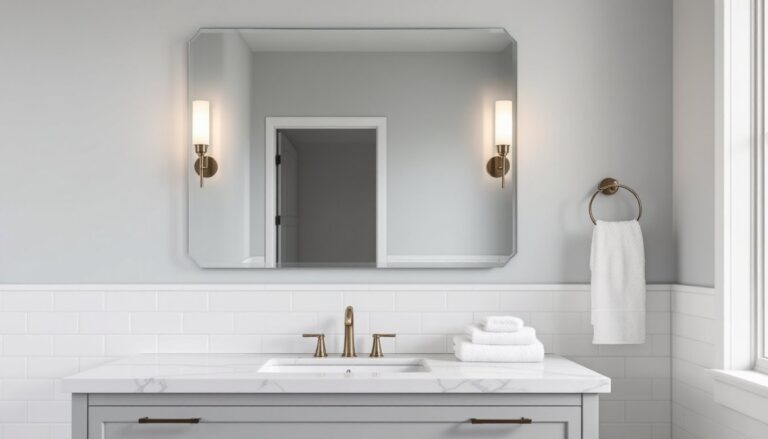
Vertical sconces mounted on either side of the mirror deliver the most even, shadow-free lighting for tasks. This setup mimics professional makeup mirrors and is especially useful in bathrooms with a single sink and narrow wall space. The Home Depot lighting department stocks dozens of sconce styles, from minimalist matte black cylinders to vintage Edison-bulb cages.
When selecting vanity lights, note the bulb type and count. Many fixtures are sold without bulbs. LED-integrated models (bulbs built into the fixture) offer energy efficiency and long lifespans, often 25,000+ hours, but can’t be swapped if one LED fails. Traditional socket-based fixtures let you choose your own bulbs and replace them as needed. For bathrooms, aim for bulbs in the 3,000K to 4,000K color temperature range (soft white to neutral white) to render skin tones accurately without the harsh blue cast of daylight bulbs.
Recessed and Flush Mount Ceiling Fixtures
Recessed lighting (also called can lights or downlights) installs into the ceiling cavity, creating a clean, modern look. Home Depot sells both new-construction housings (for open framing) and remodel housings (designed to retrofit into finished ceilings). Standard recessed cans are 4, 5, or 6 inches in diameter. Smaller 4-inch cans work well for compact bathrooms or spacing multiple fixtures: 6-inch cans provide broader coverage.
LED retrofit kits are popular for upgrading old incandescent recessed lights. These kits snap or screw into existing housings, converting them to energy-efficient LEDs without replacing the entire fixture. Expect to pay $10 to $30 per retrofit kit, and installation usually takes under five minutes per fixture.
Flush mount and semi-flush mount ceiling fixtures attach directly to a ceiling junction box. Flush mounts sit tight against the ceiling: semi-flush mounts hang a few inches down on a short stem. Both styles work well in bathrooms with standard 8-foot ceilings. For fixtures over tubs or showers, verify they’re wet-rated or damp-rated per NEC requirements. Wet-rated fixtures can handle direct water spray: damp-rated fixtures tolerate humidity and occasional splashes but shouldn’t be installed directly in a shower enclosure.
Many homeowners mix recessed lights for general illumination with a dedicated vanity fixture for task lighting. This layered approach prevents a single, overly bright overhead fixture from casting shadows on faces. Design platforms like Houzz offer thousands of bathroom layouts showing how different fixture combinations perform in real spaces.
How to Choose the Right Bathroom Lighting for Your Space
Start by measuring the bathroom and identifying existing junction boxes. Swapping a fixture on an existing box is straightforward: adding new fixtures means running cable through walls or ceilings, which increases cost and complexity.
Ceiling height and room size dictate how many lumens you’ll need. A general rule: aim for 50 to 75 lumens per square foot in bathrooms. A 50-square-foot half bath needs roughly 2,500 to 3,750 lumens total. If you’re using multiple fixtures, divide the total lumens among them. For example, four recessed LED lights at 650 lumens each deliver 2,600 lumens, adequate for a small bathroom.
Color rendering index (CRI) matters more in bathrooms than in most rooms. CRI measures how accurately a light source shows colors compared to natural sunlight (CRI 100). For bathrooms, choose bulbs with a CRI of 90 or higher so makeup, hair color, and skin tones appear true to life. Many LED fixtures at Home Depot list CRI on the packaging: if it’s not specified, assume it’s around 80, which is acceptable but not ideal.
Moisture and electrical codes are non-negotiable. Any fixture within 3 feet of a tub or shower must be rated for damp or wet locations. Check your local building codes, some jurisdictions require GFCI protection for bathroom lighting circuits, especially in older homes being renovated. If you’re unsure, consult an electrician before purchasing fixtures.
Finally, think about dimming capability. Not all LED fixtures are dimmable, and even those that are may flicker or hum if paired with an incompatible dimmer switch. Home Depot typically notes dimming compatibility on product labels. If you want adjustable lighting, confirm the fixture and switch are matched, or plan to replace the existing switch with an LED-compatible dimmer.
Interior design inspiration from sites like Homify can help visualize how different fixture styles and placements work in bathrooms similar to yours.
Top Home Depot Bathroom Lighting Styles and Trends
Matte black finishes continue to dominate bathroom fixtures in 2026. They pair well with white subway tile, marble countertops, and brushed gold hardware. Matte black vanity lights and sconces offer a modern, high-contrast look without the fingerprint smudges that plague glossy black or chrome.
LED strip lighting has moved from under-cabinet kitchen applications into bathrooms. Installing LED strips behind mirrors or under floating vanities adds ambient backlighting that’s both stylish and functional for nighttime navigation. These strips are typically low-voltage (12V or 24V) and require a driver, but installation is simpler than hardwired fixtures, most use adhesive backing and plug into an outlet.
Mixed metals are increasingly common. Pairing a brushed nickel ceiling fixture with oil-rubbed bronze sconces, or chrome faucets with matte gold lighting, creates visual interest without looking mismatched. The key is repeating each finish at least twice in the room so the mix feels intentional.
Oversized statement fixtures work surprisingly well in larger master baths. A multi-arm chandelier or a cluster of globe pendants over a freestanding tub elevates the space from utilitarian to spa-like. If you’re considering a chandelier, ensure it’s rated for damp locations and hangs at least 7 feet above the finished floor to meet code and avoid head clearance issues.
Smart lighting integration is more accessible than ever. Several Home Depot vanity lights and flush mounts now include Wi-Fi or Bluetooth connectivity, allowing control via smartphone apps or voice assistants. Some models offer tunable white light, letting users shift from warm 2700K light for evening baths to cooler 4000K for morning routines. While smart fixtures cost 20–40% more than standard models, they eliminate the need for separate smart switches.
Remodeling trends documented by resources such as Remodelista’s bath remodeling guide showcase how fixture choices impact overall bathroom aesthetics and functionality.
Installation Tips for DIY Bathroom Lighting Projects
Turn off power at the breaker before touching any wiring. Flip the bathroom light switch to confirm power is off, then use a non-contact voltage tester on the wires inside the junction box. This simple tool (under $15 at Home Depot) can prevent serious shocks.
For straightforward fixture swaps, replacing an old vanity light with a new one on the same junction box, the process typically takes 30 to 60 minutes. You’ll disconnect the old fixture’s wire nuts, remove mounting screws, connect the new fixture’s wires (black to black, white to white, ground to ground), secure the mounting bracket, and attach the fixture. If the new fixture is significantly heavier than the old one (more than 10 pounds), verify the junction box is rated for the weight. Plastic retrofit boxes aren’t always strong enough for heavy fixtures: a metal box screwed to a stud or blocking is more secure.
Recessed lighting installation is more involved. For remodel housings in finished ceilings, you’ll cut a hole using the template provided (usually 4.5 to 6.5 inches diameter depending on can size), fish cable from the switch or another fixture, connect wiring inside the housing, and clip the can into place. The clips bite into the drywall to hold the fixture. While doable for a confident DIYer, running new cable through walls or across joists can be tricky, especially in bathrooms where plumbing and ductwork often occupy the same spaces. If you’re adding more than two recessed lights or the circuit is already near capacity, an electrician should evaluate whether the circuit can handle the additional load or if a new circuit is needed.
Moisture barriers and ventilation matter. If you’re installing recessed lights in a ceiling below an unconditioned attic, use IC-rated (insulation contact) housings so insulation can safely touch the fixture without creating a fire hazard. In bathrooms with poor ventilation, moisture can accumulate in ceiling cavities and corrode electrical connections over time. Consider upgrading to an exhaust fan that moves at least 50 CFM (cubic feet per minute) for bathrooms under 100 square feet, or 1 CFM per square foot for larger baths.
Safety gear: Wear safety glasses when drilling into ceilings (drywall dust and debris fall into your eyes quickly) and use a dust mask if cutting through old plaster. If you’re working on a ladder, have a second person nearby to steady it and hand you tools.
Permit requirements vary by jurisdiction. Some localities allow homeowners to replace existing fixtures without a permit but require permits for adding new circuits or fixtures. When in doubt, check with your local building department. Pulling a permit may feel like a hassle, but it ensures an inspector verifies your work meets code, important for safety and for avoiding issues when you sell the home.
For additional lighting ideas in other areas, check out resources on ceiling lighting for home offices or explore options for LED exterior home lighting to tie your bathroom updates into a whole-home lighting plan.