Ceiling lighting in a living room isn’t just about flipping a switch and hoping for brightness, it’s the backbone of the entire room’s atmosphere. Get it right, and the space feels warm, balanced, and inviting. Get it wrong, and even the best furniture looks flat. In 2026, the approach to living room lighting has evolved beyond a single overhead fixture. Homeowners now layer sources, blend smart controls, and pick fixtures that pull double duty as functional light and visual focal points. This guide walks through the most effective ceiling lighting strategies, from recessed cans to statement pendants, with practical advice on installation, placement, and code considerations.
Table of Contents
ToggleKey Takeaways
- Living room ceiling lighting ideas work best when layered into ambient, task, and accent sources rather than relying on a single overhead fixture, avoiding the harsh ‘hospital effect’ and improving both atmosphere and energy efficiency.
- Statement chandeliers and pendants serve as visual focal points in living room designs, but must be properly mounted to ceiling boxes rated for weight and hung at least seven feet high to prevent head clearance issues.
- Recessed lighting provides clean, modern ambient light when spaced roughly half the ceiling height apart (about 4 feet for 8-foot ceilings) and paired with LED retrofit kits for long-lasting efficiency.
- Track and rail lighting systems offer flexible, design-forward control for changing room layouts, with adjustable heads that can highlight artwork, provide general illumination, and integrate with dimmer controls.
- Smart lighting controls and LED-compatible dimmers transform static fixtures into programmable zones that adapt brightness and color temperature throughout the day, supporting both productivity and relaxation.
- Always check local electrical codes, confirm ceiling box compatibility with fixture weight, and test light levels before finalizing installations to ensure safety and optimal performance in your living room.
Layered Lighting: The Foundation of Great Living Room Design
Layered lighting means combining ambient, task, and accent lighting to create depth and flexibility. Ambient lighting provides the baseline illumination, usually from ceiling fixtures. Task lighting targets reading nooks or work zones. Accent lighting highlights art, architectural features, or textures.
For ceilings, ambient sources like recessed lights or flush mounts set the foundation, while pendants or chandeliers add visual interest. Many designers now recommend placing ambient sources on separate circuits or dimmer switches so intensity can shift from bright daytime to cozy evening modes.
Layering also helps avoid the dreaded “hospital effect”, a single, harsh overhead fixture casting flat light. Instead, combining a central chandelier with perimeter recessed lights and wall sconces creates shadow variation and dimensionality. Proper layering also allows for better energy efficiency, since not all zones need full power at once.
When planning layers, sketch a simple floor plan and mark existing electrical boxes, natural light sources, and furniture zones. This helps identify gaps where task or accent lights are needed. Layered systems often integrate smart lighting controls to unify dimming and scheduling across multiple fixture types.
Statement Chandeliers and Pendant Lights
A chandelier or large pendant can anchor a living room and define its style, modern, industrial, farmhouse, or classic. These fixtures work best in rooms with ceilings eight feet or higher. For standard ceiling heights, the bottom of the fixture should hang at least seven feet above the floor to prevent head-knocking. In rooms with vaulted or two-story ceilings, scale up the fixture diameter: a good rule of thumb is to add the room’s length and width (in feet) and convert that sum to inches for the fixture diameter.
Installation requires a ceiling box rated for the fixture’s weight. Most chandeliers weigh between 15 and 50 pounds, so a standard plastic box won’t cut it, use a metal pancake box or a fan-rated box anchored to a joist or blocking. If the existing box isn’t centered where you want the fixture, consider hiring an electrician to relocate it or use a swag hook to offset the fixture without rewiring.
Pendants work well over coffee tables or sectional groupings. Cluster three pendants of varying heights for a sculptural effect, or choose a single oversized drum pendant for minimalist impact. Glass or open-cage designs allow light to spread broadly, while opaque shades direct light downward, useful over task zones.
Always check the bulb type the fixture requires. Many modern designs use integrated LED modules that can’t be replaced, so confirm the color temperature (measured in Kelvin) matches your preference: 2700K for warm white, 3000K for neutral, or 4000K for cool daylight tones.
Recessed Lighting for Clean, Modern Ambiance
Recessed lights, also called can lights or downlights, mount flush with the ceiling, making them ideal for contemporary or minimalist interiors. They’re also perfect for low ceilings where hanging fixtures would intrude.
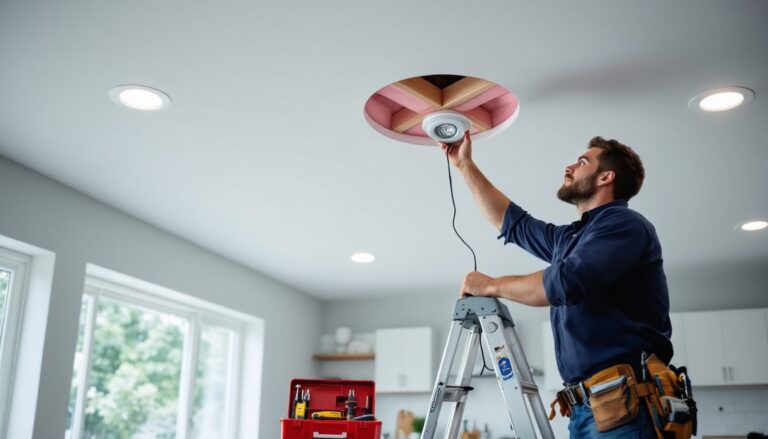
Standard recessed housings come in 4-inch, 5-inch, and 6-inch diameters. Smaller cans suit accent lighting or tight spacing: 6-inch cans provide broader ambient coverage. New-construction housings nail directly to joists before drywall goes up. Remodel (retrofit) housings use spring clips to grip finished ceilings from below, making them DIY-friendly for existing rooms.
Spacing matters: a common guideline is to place cans roughly half the ceiling height apart. For an 8-foot ceiling, that’s about 4 feet on center. Avoid placing cans too close to walls, leave at least 18 inches from the wall to the first can to prevent harsh shadows.
IC-rated (insulation contact) housings are required if insulation will touch the fixture. For energy efficiency, choose LED retrofit kits or integrated LED recessed lights: they last 25,000+ hours and use a fraction of the wattage of old incandescent BR30 bulbs. Color temperature again matters, 2700K mimics traditional warm bulbs, while 3000K feels crisp without going clinical.
Dimming recessed LEDs requires a compatible dimmer switch. Not all LED trims dim smoothly: check packaging for “dimmable” labels and pair with an electronic low-voltage (ELV) or LED-rated dimmer to avoid flickering. Some jurisdictions now require Title 24 compliance (California) or energy-star rated fixtures, so verify local codes before purchasing.
Track and Rail Lighting Systems
Track lighting has shed its 1980s reputation and re-emerged as a flexible, design-forward option. Modern systems feature sleek rails, adjustable heads, and even monorail curves that follow architectural lines. They’re especially useful in living rooms with changing layouts, move a sofa, and you can reposition a track head to match.
Track systems come in three electrical standards: H, J, and L types. They’re not interchangeable, so confirm compatibility before buying additional heads or extensions. Most residential systems use H-type. Linear track mounts directly to the ceiling and accepts multiple heads along its length. Monorail uses low-voltage cable, allowing sculptural bends and custom shapes, but requires a transformer.
Installation is straightforward if you’re replacing an existing ceiling fixture: the track’s power feed connector mounts to the standard electrical box, and the track extends from there. For longer runs or layouts without a central box, you may need to add junction boxes or hire an electrician to hard-wire multiple feed points.
Track heads come in floods, spots, and decorative pendants. Use narrow-beam spots (15–25 degrees) to highlight artwork, and wider floods (40+ degrees) for general illumination. Aim heads to avoid glare: position them so the beam hits surfaces, not eyes.
Many home lighting stores carry modular track kits that allow mixing head styles on one rail. Pairing track with dimmer controls adds versatility, letting users dial down intensity for movie nights or ramp up for game nights.
Flush Mount and Semi-Flush Fixtures for Low Ceilings
Flush-mount fixtures sit directly against the ceiling, with no gap. Semi-flush mounts drop a few inches on a short stem. Both work well in rooms with 7.5- to 8-foot ceilings where chandeliers would hang too low.
Flush mounts typically house two to three bulbs under a glass or fabric shade. They’re easy to install, most mount to a standard round or octagonal ceiling box with two screws and a wire-nut connection. Turn off the breaker, remove the old fixture, match black (hot) to black, white (neutral) to white, and bare copper (ground) to the green screw or bare wire. Tuck wires into the box, mount the base, and attach the shade.
Semi-flush fixtures add a bit more style with a short drop and larger shade, offering better light distribution than true flush mounts. They suit transitional or traditional interiors. For modern or industrial looks, consider drum or disc-shaped flush mounts with integrated LEDs.
One challenge with flush and semi-flush lights is bulb access. Some designs require removing the entire shade or base to change bulbs. Choose fixtures with easy-access panels or integrated LEDs rated for 25,000+ hours to minimize maintenance.
Code-wise, the National Electrical Code (NEC) requires ceiling fixtures in habitable rooms to be switched at the entry. If your living room lacks a ceiling box, you’ll need to either install one (cutting into drywall and fishing cable) or use a plug-in swag fixture with a wall switch controlling the outlet. The latter is easier but less clean-looking. If you’re comfortable with basic wiring and have attic access above the room, adding a box is manageable: otherwise, hire a licensed electrician.
Smart Lighting and Dimmer Controls
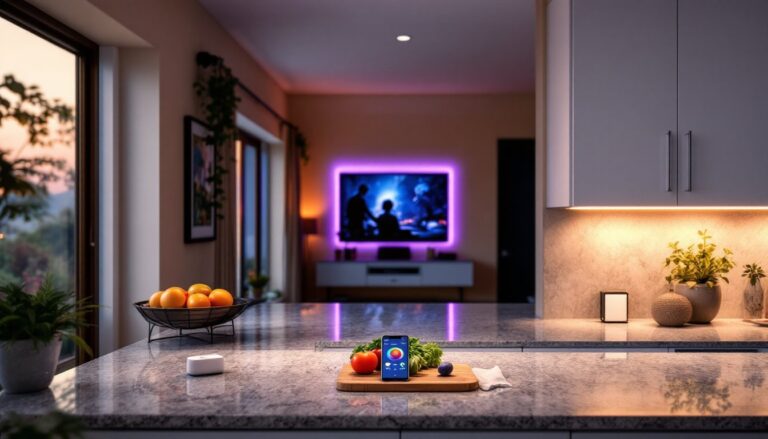
Smart lighting transforms static ceiling fixtures into programmable zones. Systems like Philips Hue, LIFX, and Lutron Caseta let users adjust brightness, color temperature, and even hue from a phone app or voice assistant. Many integrate with home automation platforms for scheduling and scene presets, “movie mode” dims ambient lights and kills accent lights, while “reading mode” boosts task lighting.
Smart bulbs are the simplest entry point: screw them into existing fixtures and control via Bluetooth or Wi-Fi. No wiring changes needed. The downside? If someone flips the physical switch off, the bulbs lose power and go offline. Smart switches solve this by replacing the wall switch itself. They require a neutral wire in the switch box (common in post-1980s homes but absent in many older builds). If no neutral is present, look for switches like the Lutron Caseta that use a hub to bypass the neutral requirement, or hire an electrician to pull a neutral.
Dimmer switches improve any ceiling fixture, smart or not. LED-compatible dimmers prevent the flicker and buzz common with older incandescent dimmers. Install by turning off the breaker, removing the old switch, connecting the dimmer’s wires (usually black to hot, ground to ground, and sometimes a neutral), and mounting the dimmer in the box. Test with the breaker back on.
For office ceiling lighting or multipurpose living spaces, programmable dimmers allow preset brightness levels, 100% for daytime work, 30% for evening relaxation. Some dimmers offer “adaptive lighting” that shifts color temperature throughout the day, mimicking natural light cycles. Studies on interior design trends show that circadian-friendly lighting improves mood and focus, making it a worthwhile upgrade beyond basic on-off switching.
When mixing smart and traditional fixtures, ensure all are on compatible dimmer circuits. Not all LEDs dim to zero, and mixing dimmable with non-dimmable bulbs on one circuit causes uneven performance. Read spec sheets and test before committing to a full-room install.
Conclusion
Ceiling lighting in a living room is about more than picking a pretty fixture, it’s about layering sources, matching scale to room dimensions, and integrating controls that adapt to how the space is used. Whether it’s a statement chandelier, a grid of recessed cans, or a flexible track system, the right combination turns a flat, one-note room into a dynamic, comfortable environment. Take time to plan circuits, confirm code requirements, and test light levels before finalizing installations. The result is a living room that works as hard as it looks good.