Installing deck lighting isn’t about making the backyard look like a sports stadium. It’s about extending usable hours, improving safety, and highlighting the craftsmanship already there. A well-lit deck turns an evening gathering from a flashlight-and-candles affair into something comfortable and intentional. Whether the goal is subtle accent lighting along steps or a full perimeter glow, the right fixtures and a solid plan make the difference between a weekend project and a rehash three months later.
Table of Contents
ToggleKey Takeaways
- Deck lighting installation improves safety by illuminating high-risk areas like steps and level transitions, reducing trip hazards and liability while extending your deck’s usable hours into the evening.
- Post cap, railing, and recessed step lights are the primary fixture types, each suited to different purposes—post caps for perimeter definition, step lights for safety, and recessed lights for pathways without tripping hazards.
- Low-voltage systems deliver consistent brightness year-round and support easy expansion, while solar options eliminate wiring but require full sun exposure and periodic battery replacement every 2 to 4 years.
- Proper spacing and voltage drop planning are critical: post cap lights need one per post, railing fixtures should be 3 to 4 feet apart, and wire gauge must increase on runs over 100 feet to prevent dimming.
- A complete low-voltage deck lighting installation can be completed in a weekend using a transformer, outdoor-rated wire, gel-filled connectors, and attention to moisture sealing around recessed fixtures.
- Hybrid layouts combining low-voltage task lighting for steps with solar fixtures for decorative post caps balance reliability and installation ease for most residential decks.
Why Install Deck Lighting?
Deck lighting serves three core purposes: safety, usability, and aesthetics. Safety comes first, unlit steps and transitions between deck levels are common trip hazards after dark. Lighting those zones reduces liability and keeps guests from testing the structural integrity of a railing with their shin.
Usability extends the deck’s functional hours. A well-lit space allows grilling, reading, or conversation without relying on harsh porch floods that wash out everything. Controlled, layered lighting creates zones: bright task lighting near the grill, softer ambient lighting for seating areas.
Aesthetics matter, too. Properly placed fixtures highlight railings, post caps, and architectural details. They can emphasize landscaping edges or create visual separation between the deck and yard. Strategic LED exterior home options bring energy efficiency to the equation without sacrificing output. Unlike old incandescent patio bulbs that burned hot and died fast, modern LEDs last years and draw minimal power.
Types of Deck Lighting to Consider
Post Cap and Railing Lights
Post cap lights mount directly onto 4×4 or 6×6 deck posts, replacing or sitting atop the existing cap. They’re ideal for perimeter definition and ambient glow. Most models are available in solar or low-voltage versions. Solar post caps work well in full-sun locations but may underperform in shaded yards or during winter months with short days. Low-voltage post caps require wiring but deliver consistent output regardless of weather.
Railing lights integrate into the top or bottom rail, often as small LED strips or puck-style fixtures. Bottom-mount rail lights create a “floating” effect and illuminate deck boards without glare at eye level. Top-mount options light the railing itself, useful for highlighting decorative balusters or cable rail systems. These fixtures typically require running wire through or along the railing, check the rail design before buying. Hollow composite or vinyl rails simplify wire routing: solid wood rails may need surface conduit or shallow dados routed along the back.
Recessed and Step Lights
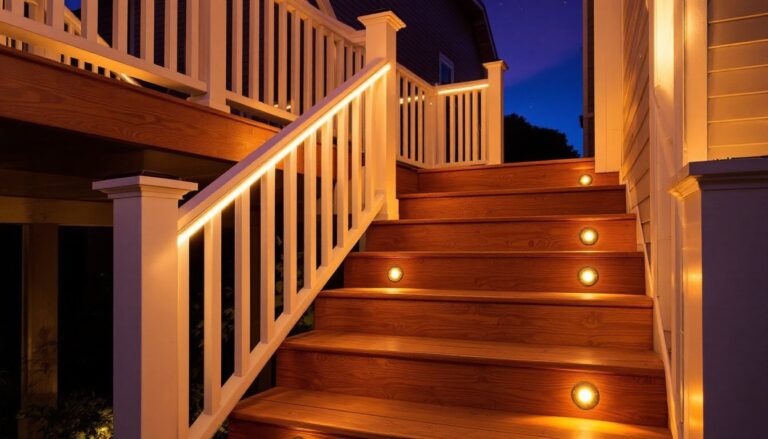
Recessed deck lights (sometimes called deck dots or puck lights) mount flush with the deck surface or riser. They’re best for steps, transitions, and pathways where protruding fixtures create tripping hazards. Installation involves drilling a hole sized to the fixture housing, running wire, and securing the unit from below. Most recessed lights are low-voltage LEDs rated for wet locations (look for IP65 or higher ratings).
Step lights specifically target riser faces, the vertical boards between treads. Mounting a small fixture on each riser provides clear visual cues in low light. According to This Old House, step lighting is one of the most effective safety upgrades for multi-level decks. Standard step light housings are 2 to 3 inches wide and about 1 inch deep, fitting easily into most riser configurations.
Both recessed and step lights require access beneath the deck for wiring. If the deck sits close to the ground or lacks accessible joists, surface-mount alternatives or solar options may be more practical.
Planning Your Deck Lighting Layout
Start with a sketch. Mark post locations, steps, seating areas, and any obstacles (planters, grills, furniture). Identify high-traffic zones and transitions that need task lighting, then layer in ambient fixtures for overall glow.
Spacing guidelines: For post cap lights, one fixture per post is standard. For railing lights, space puck-style fixtures 3 to 4 feet apart along continuous runs to avoid dark gaps. Step lights go on every riser, skipping steps creates uneven illumination and defeats the safety purpose. Recessed deck lights can be spaced 4 to 6 feet apart for path lighting or clustered tighter for accent zones.
Consider voltage drop when planning low-voltage runs. Most low-voltage systems operate at 12V DC, supplied by a transformer mounted near an exterior outlet. Long wire runs (over 100 feet) can cause dimming at the far end of the circuit. To compensate, use heavier gauge wire (12 AWG or 10 AWG instead of standard 16 AWG) or split the layout into multiple circuits. Transformer capacity also matters, add up the wattage of all fixtures and choose a transformer rated at least 20% above that total to avoid overload.
For solar setups, map sun exposure throughout the day. Post caps in full southern exposure will charge reliably: those shaded by trees or roof overhangs won’t. Mixing solar and low-voltage fixtures is common, use solar where it works, hard-wire where it doesn’t.
Local codes may require permits for low-voltage outdoor lighting if it’s tied into household circuits or if trenching crosses property lines. Most jurisdictions treat low-voltage deck lighting as non-permit work, but verify before starting. If adding new circuits or running wire longer than 150 feet, a licensed electrician may be required depending on state and local electrical codes. Exploring exterior home lighting ideas can help refine the design before committing to a plan.
Step-by-Step Installation Guide
Tools and materials:
- Low-voltage transformer (sized to total fixture wattage)
- Low-voltage landscape wire (12 AWG or 14 AWG)
- Wire connectors (gel-filled or crimp-style rated for outdoor use)
- Drill with hole saw (sized to recessed fixture diameter)
- Wire strippers and cutters
- Screwdriver or impact driver
- Deck lights (post cap, recessed, step, or railing fixtures)
- Cable staples or conduit clips
- Exterior-rated silicone sealant
- Safety glasses, gloves
Installation steps:
-
Mount the transformer. Position it near an exterior GFCI outlet, ideally within 10 feet. Most transformers are weather-resistant but perform best under an eave or in a covered junction box. Follow manufacturer instructions for wire terminal connections. Many include a built-in photocell or timer, set these after testing the system.
-
Run the main wire. Route low-voltage cable from the transformer to the deck. If crossing open ground, bury wire 6 inches deep in conduit to protect it from mower blades and foot traffic. Along the deck frame, secure wire to joists or beams with cable staples every 18 to 24 inches. Avoid tight bends that stress the copper.
-
Install post cap lights. Remove existing post caps if present. Some post cap lights slip over the post top: others screw directly into the 4×4. Drill a small hole through the post side near the base for wire entry, feed wire up through the post, and connect to the fixture’s leads. Cap the post, seal any gaps with silicone, and run wire down to the main line.
-
Mount recessed and step lights. Mark fixture locations on deck boards or risers. For recessed lights, drill a hole using a hole saw matched to the fixture diameter (commonly 2.5 or 3 inches). Feed wire through from below, connect fixture leads, and press the housing into place. Most recessed fixtures have spring clips or flanges that grip the deck board from beneath. For step lights, drill pilot holes, attach the fixture to the riser face with screws, and connect wiring.
-
Splice connections. Use gel-filled wire nuts or heat-shrink butt connectors rated for outdoor/wet locations. Standard twist-on wire nuts corrode outdoors and fail within a season. Strip 1/2 inch of insulation, twist wires together, cap with the connector, and tug to test. Secure splices to the deck frame so they don’t hang loose.
-
Test the system. Plug in the transformer and verify each fixture lights up. If any are dim or non-functional, check connections and measure voltage at the fixture. Voltage below 10.8V indicates excessive drop, shorten the run, upsize wire, or add a second transformer.
-
Secure and seal. Once everything works, staple all loose wire runs, apply silicone around recessed fixture edges to prevent moisture intrusion, and tidy up any exposed cable with conduit clips. Program the transformer’s timer or photocell to desired on/off times.
Safety note: Always wear safety glasses when drilling overhead or into deck boards. Splinters and sawdust fly unpredictably. If the deck structure is older or unknown, probe with a voltage tester before drilling into posts or joists, buried staples or old wiring may still be live. Resources like Bob Vila offer troubleshooting guides if voltage drop or connection issues arise during installation.
Low-Voltage vs. Solar Deck Lighting
Low-voltage systems deliver consistent performance regardless of weather or season. They draw power from a transformer plugged into a standard 120V outlet, stepping voltage down to 12V DC. This means predictable brightness, longer fixture life, and the ability to run dozens of lights on a single circuit. Low-voltage installations require more upfront labor, running wire, making connections, mounting a transformer, but the result is reliable and easily expandable. Transformers range from 50W to 300W capacity: a typical 15-fixture deck layout draws around 60 to 90 watts total.
Solar lights eliminate wiring entirely. Each fixture has an integrated solar panel and rechargeable battery. They’re ideal for retrofit projects where running new wire is impractical or for distant post caps far from power sources. The tradeoff is performance variability. Cloudy stretches, winter days with limited sun, or shaded locations result in dim or short-lived output. Battery life degrades over time, expect to replace batteries every 2 to 4 years. Solar fixtures are also harder to synchronize: some may turn on earlier or later than others based on individual charge levels.
Cost comparison depends on scale. Solar post caps run $15 to $40 each with no installation costs beyond screwing them on. Low-voltage fixtures cost $10 to $30 each, plus transformer ($50 to $150), wire ($0.30 to $0.80 per foot), and connectors. For a 12-fixture project, low-voltage materials total around $250 to $400, while solar might be $180 to $480, but solar offers no room for upgrades or added fixtures without buying more standalone units.
Hybrid layouts make sense for many decks: low-voltage for critical step and task lighting, solar for decorative post caps in sunny locations. This approach balances reliability with installation ease. For those planning broader outdoor upgrades, low-voltage systems integrate cleanly with other landscape lighting and can be controlled via smart switches or timers. Detailed comparisons and project walkthroughs are available on Instructables, where DIYers share both successes and cautionary tales.
Deck lighting transforms an underused space into a year-round asset. With the right fixtures, a clear plan, and attention to wiring details, most homeowners can complete a full installation in a weekend. The result is safer steps, extended evenings outdoors, and a deck that looks as intentional at night as it does during the day.