Planning outdoor lighting without a visual reference is like framing a deck in the dark, you might get it done, but you’re guessing more than you should. Landscape lighting images give homeowners a clear picture of what works, where fixtures should go, and how different techniques create mood, safety, and curb appeal. Whether you’re lighting a front walkway for safety or adding drama to a backyard oak, good reference photos show you the difference between a well-lit yard and one that looks like a stadium parking lot. This guide breaks down 50+ real-world lighting examples across pathways, trees, patios, gardens, and water features to help you design a system that’s both functional and striking.
Table of Contents
ToggleKey Takeaways
- Landscape lighting images serve as practical blueprints for fixture placement, spacing, and layering, helping homeowners avoid common design mistakes like dark patches and uneven coverage before installation begins.
- Pathway lights should be spaced 8–10 feet apart on straight runs and 6 feet on curves, with fixture height (bollard-style at 16–24 inches or stake lights at 8–12 inches) chosen based on walkway width and sightlines.
- Uplighting transforms trees and architectural features into focal points by mounting fixtures 12–18 inches from trunks or 6–12 inches from walls using narrow beams (10–25 degrees), with wattage scaled to structure size (3–7W for most applications).
- Deck and patio lighting combines task and ambient layers—recessed stair lights, post caps, and string lights—with proper spacing, structural support rated for outdoor use, and GFCI protection for safety.
- Garden accent lighting should highlight 3–5 focal points per bed using spotlights or moonlighting techniques, with warm white (2700K) for warm-toned plants and neutral white (3000K) for accurate color rendering.
- Water feature and pool lighting must comply with National Electrical Code Article 680 requirements, including low-voltage systems, GFCI protection, and IP68-rated submersible fixtures, with permits required in most jurisdictions.
Why Landscape Lighting Images Are Essential for Planning Your Outdoor Design
Most DIY landscape lighting fails happen at the design stage, not the installation. Homeowners underestimate fixture count, choose the wrong beam angles, or space lights too far apart, then end up with dark patches and uneven coverage.
Landscape lighting images solve this by showing you fixture placement, spacing, and layer effects before you drill a single hole. A good photo reveals whether uplights should sit 12 inches or 36 two inches from a tree trunk, how many path lights you need per 10 feet of walkway, and what color temperature (2700K warm white vs. 3000K neutral) suits your home’s exterior.
Images also help you communicate with electricians or irrigation contractors if you’re tying low-voltage lighting into an existing system. Instead of saying “I want it to look nice,” you can point to a specific example and say, “I want this beam spread on my columns and that glow under the deck stairs.”
Finally, reference photos prevent over-buying. Retailers push kits with 20+ fixtures, but most front yards need 8–12 well-placed lights max. Study images of homes similar to yours in size and style, Colonial, Craftsman, ranch, modern, and you’ll dial in the right quantity and wattage without guesswork.
Pathway and Walkway Lighting Inspiration
Path lights are the workhorse of landscape lighting. They guide foot traffic, mark elevation changes, and reduce trip hazards after dark. The best pathway lighting images show fixtures spaced 8 to 10 feet apart on straight runs and closer, about 6 feet, on curves or steps.
Fixture height matters. Bollard-style lights (16 to 24 inches tall) work for wide walkways and driveways. Shorter stake lights (8 to 12 inches) suit narrow garden paths or tuck into flower beds without blocking sightlines. Look for images that show the light pool on the ground, you want overlapping circles of illumination, not spotlights with dark gaps in between.
Material choice affects durability. Cast aluminum and powder-coated steel fixtures hold up in freeze-thaw climates better than plastic. Brass and copper develop a patina over time, which some homeowners love and others hate, find images of aged fixtures to decide.
For a cleaner look, consider using lighting with modern LED exterior home lighting that provides consistent color and brightness with minimal maintenance. Many pathway photos on Gardenista feature low-profile lights that disappear during the day and deliver soft, even illumination at night.
Avoid the “runway effect”, two perfectly symmetrical rows of lights lining a path. Stagger fixtures slightly or alternate sides for a more natural feel. Images from Country Living often showcase rustic, asymmetric path lighting that feels organic rather than engineered.
Dramatic Uplighting for Trees and Architectural Features
Uplighting transforms trees, columns, stone walls, and facades into nighttime focal points. The technique is simple, mount a fixture at ground level, aim it upward, but the results depend entirely on placement and beam angle.
For trees, place the uplight 12 to 18 inches from the trunk and use a narrow beam (10–25 degrees) to graze the bark and highlight texture. Wide-canopy trees like oaks and maples benefit from two or three fixtures positioned around the base to eliminate shadows and create depth. Images of uplighting on trees should show distinct branch structure, not just a glowing blob.
For architectural features, brick chimneys, stone veneer, stucco columns, mount fixtures 6 to 12 inches from the wall and angle them to graze the surface. This technique, called wall washing, emphasizes texture and dimension. Smooth surfaces (painted wood, flat siding) don’t benefit much from uplighting: save it for materials with visual interest.
Wattage matters. Most uplights run 3 to 7 watts (LED equivalent of 20–50W incandescent). A 20-foot oak needs a 5–7W fixture: a 10-foot ornamental tree does fine with 3W. Over-lit trees look artificial and waste energy.
Safety note: If you’re uplighting near a structure, check local codes. Some jurisdictions require low-voltage systems (12V) for fixtures within 10 feet of a home’s foundation. Always use a GFCI-protected transformer for outdoor lighting.
Deck, Patio, and Outdoor Living Space Lighting Ideas
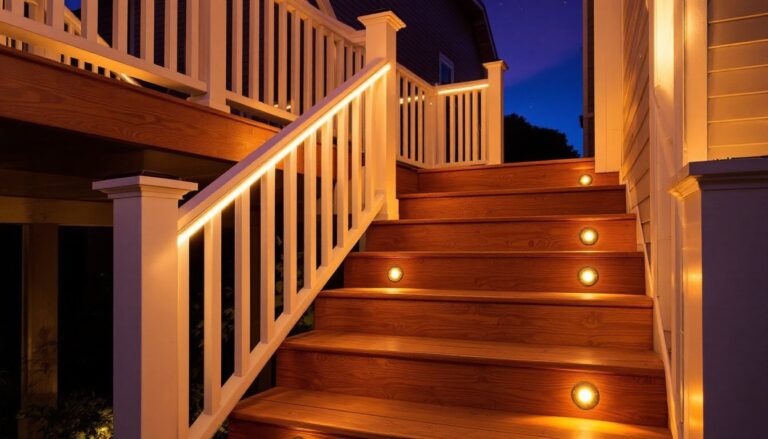
Deck and patio lighting blends task lighting (grilling, dining) with ambient lighting (mood, safety). The best images show layered systems: recessed deck lights, post cap lights, and string lights or pendants over seating areas.
Recessed deck lights install flush in stair risers, under railings, or along the deck perimeter. They prevent trips and define edges without taking up space. Standard cutouts are 2.5 to 3 inches in diameter: look for housings rated for wet locations (not just damp). Images should show even spacing, typically one light per step and every 4 to 6 feet along railings.
Post cap lights sit atop 4×4 or 6×6 deck posts and provide downward illumination. They’re easy to install (most just friction-fit or screw on) and come in solar or low-voltage versions. Solar works if posts get 6+ hours of sun: otherwise, hardwire into a low-voltage system for consistent brightness.
String lights and pendants add atmosphere but need structural support. Don’t hang string lights from flimsy hooks, use screw eyes rated for 50+ pounds anchored into solid wood joists or beams. For permanent installations, consider weather-resistant Edison-bulb strings or exterior home lighting ideas featuring café-style fixtures.
If you’re installing lighting on a new deck, run conduit and junction boxes during framing. Retrofitting lights into finished decks means fishing wire under decking boards or surface-mounting, not impossible, but messy. HGTV often features deck lighting walkthroughs that show both new-build and retrofit approaches.
Garden and Flower Bed Accent Lighting Designs
Garden accent lighting highlights plantings, sculptures, and focal points without overpowering them. The goal is subtle drama, think museum gallery, not car dealership.
Spotlight fixtures with adjustable heads work well for statuary, fountains, or specimen plants (Japanese maples, ornamental grasses). Mount them 2 to 4 feet away from the subject and use a narrow to medium beam (15–35 degrees). Too close and you’ll create harsh shadows: too far and the light dissipates.
Moonlighting mimics natural light by mounting downlights high in trees and aiming them toward the ground. This technique casts dappled shadows through branches and illuminates flower beds from above. It’s trickier to install, you need a ladder, tree-friendly mounting hardware, and a longer wire run, but the effect is worth it. Look for images that show soft, filtered light rather than bright spotlights.
Color temperature affects plant appearance. Warm white (2700K) flatters reds, oranges, and yellows but mutes blues and purples. Neutral white (3000K) renders colors more accurately. If your garden features a lot of cool-toned flowers (lavender, salvia, blue hydrangea), test a 3000K fixture before committing to a full system.
Avoid lighting every plant. Choose 3 to 5 focal points per bed and leave some areas dark for contrast. Over-lit gardens feel busy and lack depth. Many homeowners exploring home up lighting techniques find that less is more when it comes to garden accents.
Water Feature and Pool Lighting Imagery
Water and light create instant drama, but they also introduce electrical safety concerns. All pool and water feature lighting must meet National Electrical Code (NEC) Article 680 requirements, which mandate low-voltage systems, GFCI protection, and specific bonding protocols.
Submersible lights install inside ponds, fountains, or pool walls. Use fixtures rated IP68 (fully submersible) and check voltage, most run 12V AC or DC. LED submersibles last 30,000+ hours and produce less heat than halogen, which matters if you have fish or plants.
Uplighting from below the waterline creates a glowing effect in shallow fountains and koi ponds. Position lights to illuminate moving water (spillways, waterfalls) rather than still surfaces, which just reflect glare. Images should show light diffused through water, not harsh beams.
Perimeter lighting around pool decks uses the same principles as patio lighting, recessed fixtures in coping, post lights along fencing, or bollards marking steps and grade changes. Keep fixtures at least 5 feet from the water’s edge unless they’re rated for wet locations.
Before installing pool or fountain lighting, check if your jurisdiction requires a permit. Most do for anything hard-wired into 120V circuits: low-voltage systems (under 30V) often don’t. When in doubt, hire a licensed electrician familiar with NEC 680. Water and electricity aren’t forgiving.
Conclusion
Landscape lighting images aren’t just inspiration, they’re practical blueprints for fixture placement, spacing, and layering. Use them to plan your system, communicate with contractors, and avoid the common pitfalls of over-lighting or poor coverage. Start with one zone (pathway, tree, or patio), test your layout, and expand from there. Good outdoor lighting improves safety, extends usable hours, and adds real value to your property, no Pinterest mood boards required.